6 Pillars
I've been thinking about thinking about organizing all the skills and knowledge needed for complete musicianship and here is what I came up with.
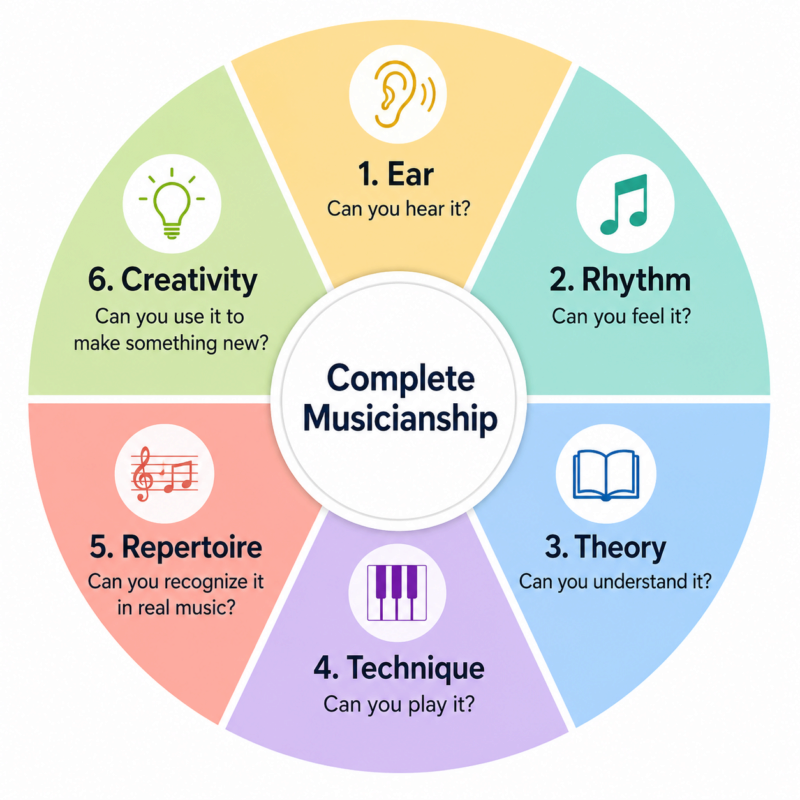
- Ear
- Rhythm
- Theory
- Technique
- Repertoire
- Creativity
These are in rough order of importance. These core pillars have a lot of overlap.
Ear
Without a good understanding of theory it is hard to understand what you are hearing. Someone with a "good ear" will by necessity have a good grasp of chord progressions and scales.
Every lesson I teach I start with something by ear. Even playing the most simple tunes by ear right from the beginning of study ties together so many skills.
Beginning students who can't play dotted rhythms on the page can usually get Row Row Row Your Boat without too much difficulty. They can get an good intuitive sense of how rhythm, melody, scales, and chords work in actual tunes (see folk tune list).
Rhythm
This is one of the hardest things to teach.
Jazz and Classical feel time differently. Classical is more elastic. Jazz is more groove based.
Theory
Putting names to things really helps a lot. Music theory gives you a common language to talk about music. Once you have a name for a dominant chord or secondary dominants it becomes much easier to describe what you are hearing.
There is this old idea of the magician, that to have a name for something gives one mastery over it.
Technique
I recently started learning the violin with my son. I have a lot of deep knowledge of music but I can't really apply it to the violin until I gain the facility at the instrument.
Repertoire
Each music genre has it's own body of repertoire. For Jazz musicians it's Jazz Standards and tunes from the Great American Songbook. My wife recently got involved in the local folk music scene and they have their own list of Celtic tunes and folk tunes they jam on together. For classical piano it's Bach, Beethoven, Brahms. For violin it's the Suzuki books. These are the pieces everyone knows for that instrument or genre.
In the process of mastering that repertoire you gain the technique and rhythm. If you apply yourself you can also really understand the theory and improve your ear.
I recently got a new piano student that could play really well, however his ear and theory were really underdeveloped and it was really holding him back.
Just learning a Mozart sonata by learning the black dots on the page will not develop your theory or improve your ear unless you really dig in.
Take apart and transpose cadence patterns, sing melodies, transpose them to different keys, analyze the chord structure. Where do things repeat? How does it vary?
Creativity
Composing, improvising, developing new exercises. Creativity really ties all the skills together.
Can you synthesize what you know about music to create something new?